
Written by Jay O’Connell
Philip Winser was a member of the Kaweah Co-Operative Colony. He had supported the socialist community experiment from Kent, England, finally joining the colony in February of 1891. After booking passage on the Cunarder Cephalonia from Liverpool to Boston, and a train ride across America, he made his was to Visalia and boarded the biweekly stage for Kaweah, unaware he was joining an endeavor that was limping along on it last days of viability.
During the last year of the Kaweah Colony’s existence, after Sequoia National Park had been created and subsequently enlarged, effectively nullifying the socialist community’s timber claims, and after Colony leaders were arrested for logging on those same nullified claims, a last ditch effort at economic survival was instituted. The struggling co-operative acquired the lease on Atwell’s Mill, and moved their logging and milling operation there. First owned by Isham Mullenix during the end of the Mineral King mining rush, it was sold to A.J. Atwell in 1885, and well-to-do Colony member, Irvin Barnard, acquired the lease in May, 1891.
New colony resident-member Phil Winser became one of the work crew at Atwell’s Mill, as it continued to be known, that summer. It was a difficult time for the colony, as government interference continued even at that privately-owned and legally-lease logging operation. Legal battles also continued from charges faced over cutting timber at their earlier operation at Colony Mill. And in-fighting and personality struggles hampered any semblance of true cooperation at the so-called Co-Operative Colony.
As that difficult summer wore into mid-August, a well-needed recreative respite was in order for Colony members working and living at Atwell’s Mill. Phil Winser described an outing that many who enjoy Mineral King’s great scenery and hiking will certainly appreciate and perhaps find familiar to their own experiences, especially those who have reached Sawtooth’s summit.
The account, from the Colony-published Kaweah Commonwealth in August, 1891, reads as follows:
After supper, on the evening of August 15, Comrades Westervelt, Clark, Winser, Al Restone, Albie Martin, Ralph Hopping and Willie Purdy started [from Atwell’s Mill] for Mineral King and had a lovely moonlight walk through the pines. We found the rest of the party, consisting of Mrs. Brann, Mrs. Sully, Mrs. Westervelt, Jim Bellah, Ray Brann, Walter Boggs, Miss Abbie and Emma Purdy camped by the river, and stayed up by the fire until late listening to George Clark’s violin and Al Redstone’s comicalities.
The ladies then betook themselves to their sleeping place—the wagon—and the rest of us spread down with our feet to the fire as closely as sardines in a box, for the nights at Mineral King are rather chilly.
An early breakfast with the usual difficulties of camp cookery, a saddling of the two mules for the ladies to ride, by turns, and the start was made by 7:30; two of the party, the only wise ones, we came to think afterward, electing to remain in camp.
A few dilapidated wooden houses, a lot of tents and other camping accessories, tamarack trees and a very temporary population of about two hundred people seemed to be the principal feature of Mineral King “town,” but it is the surroundings, and not the town, which are so interesting to the visitor. The mountain trail leading to our destination was rough and narrow. The mule riders must have had great confidence in the sure-footedness of their steeds.
At first we passed through dwarf manzanita, chaparral and other low brush. Higher up are a scattering of tamarack, juniper and pinyon trees looking terribly weather beaten and gnarled. We kept up a sharply rising valley between two ridges, the “Saw Tooth” rising high before us. About ten o’clock we reached the first patch of snow and of course snowballing followed. It was strange to see and feel it with a bright sun overhead and green grass, brilliant flowers, butterflies and humming birds all around.
At the foot of the high ridge, which is crowned by the distinctive shaped pile we meant to scale, are two lakes—Upper and Lower Monarch—blue as the sky and cold as snow water. Here the mules were hobbled and left to enjoy a bountiful feed of grass, for the trail was no more.
Now climbing began in earnest. Rotten granite slopes at first where one’s feet sank in and backward at every step and the grade steep enough to require the use of hands. From a distance the mountain appears the most barren looking pile imaginable, but almost at every step we found flowers of many kinds, their bright colors contrasting beautifully with the grey and brown of their sterile background. Even the minute snow fungus indigenous to the Alps and Sierra Nevada were there tingeing the snow patches with a light pink.
There is no regular route to the top of our mountain for there are few places where the rocks cannot be climbed. It appears to be more a pile of broken pieces than a succession of solid cliffs; the climbing, however, was very hard on the ladies, and when the top was reached they were very tired.
The view and grand breeze, however, seemed to do them a world of good and indeed it was worth all the labor of getting there. All around were mountains of every size and shape, we apparently being on the highest peak and looking down on all. Mount Whitney could be plainly seen looking as though sprinkled with snow. Jim Bellah thought he could recognize Mount Shasta also. The San Joaquin valley was rather obscured by the smoke hanging in the air from the numerous fires; but the source of the Kaweah could be traced, and it is said, that with a glass, on a clear day, the yellow of the cornfields can be seen, also the coast range and Pacific ocean beyond.
Right below us, for on one side the descent is sheer precipice, was another of those deep blue lakes some thousand feet down and looking as though a pebble could be tossed into it. We were about 13,300 ft. above the sea [actually the peak is listed at 12,348 ft], but a humming bird seemed quite at home there and buzzed by like a large insect.
After drinking in a scene the like of which I had never beheld before, we were obliged to tear ourselves away. The descent was accomplished in far less time than it took to go up; but it was not done without considerable exertion, and I suppose there was no one of the party but was heartily glad when the lakes were reached again and the accumulation of fine granite could be emptied out of boots, and droughts of that crystal water be taken.
The rest of the return journey was accomplished safely, but camp was not reached until after dark and we were very glad the two had stayed behind for supper was ready and we were ready for it. Too late to get back to Atwell’s that night, so the workers made an early start next morning and got there in time for breakfast and the day’s usual labor.

The “Saw Tooth” rising high before us. 
An issue of The Kaweah Commonwealth, published by the Kaweah Colony. 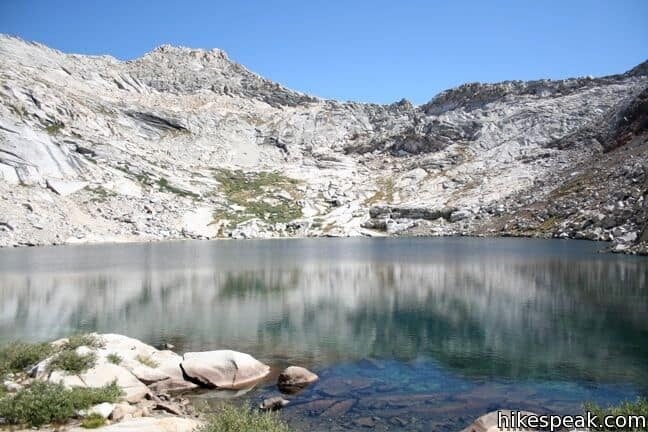
Upper Monarch Lake 

Jay O’Connell grew up in Three Rivers, but now lives in the Los Angeles area where he works in the television industry. A frequent contributor to 3 Rivers News, he is the author of several books on local history, including Train Robber’s Daughter: The Melodramatic Life of Eva Evans and Co-Operative Dreams: A History of the Kaweah Colony which will be re-issued as e-book later this year. He enjoys hiking in the Mineral King area, but hasn’t been up on Sawtooth since he was in his twenties (a long, long time ago!)